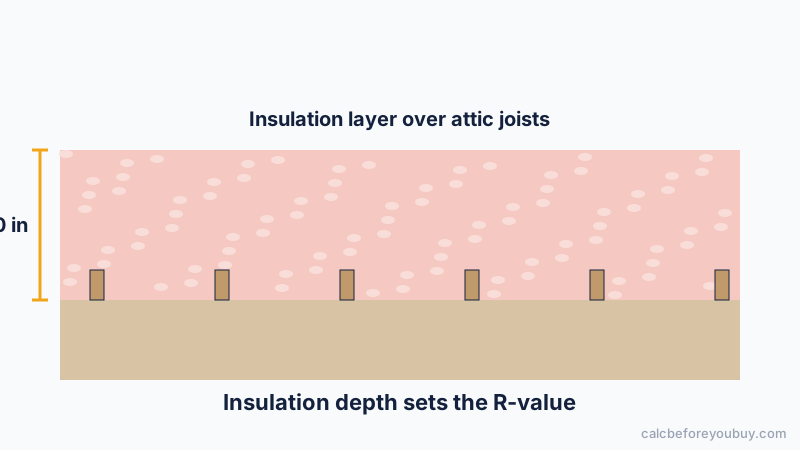
How the insulation calculator works
What R-value does an attic need?
ENERGY STAR publishes retrofit recommendations by climate zone. For an attic with little or no insulation, the targets are R-30 in zone 1 (the warmest parts of the country), R-49 in zones 2 and 3, and R-60 in zones 4 through 8. If the attic already has 3–4 inches, the recommended levels are R-25, R-38 and R-49 respectively.
| Climate zone | Uninsulated attic | Attic with 3–4 in existing |
|---|---|---|
| 1 | R-30 | R-25 |
| 2–3 | R-49 | R-38 |
| 4–8 | R-60 | R-49 |
R-value per inch by material
Different materials insulate differently per inch, so the same target R needs different depths:
| Material | Typical R per inch | Inches for R-49 |
|---|---|---|
| Blown fiberglass | R-2.5 | 19.6 in |
| Blown cellulose | R-3.5 | 14 in |
| Fiberglass batts | R-3.2 | 15.3 in |
| Mineral wool batts | R-3.3 | 14.8 in |
| Open-cell spray foam | R-3.6 | 13.6 in |
| Closed-cell spray foam | R-6.5 | 7.5 in |
Tips before you add insulation
- Air-seal first: gaps around light fixtures, pipes and the attic hatch leak more heat than thin insulation does.
- Keep insulation away from recessed lights not rated for contact and maintain clearance around chimneys and flues.
- Install baffles so soffit vents stay open.
- Blown-in insulation settles; bag charts list both installed and settled thickness — use the settled figure.
Sources
- ENERGY STAR — Recommended Home Insulation R-Values
- U.S. Department of Energy / ENERGY STAR — Consumer Guide to Home Insulation (PDF)
Frequently asked questions
How many inches is R-49 insulation?
About 19.6 inches of blown fiberglass (R-2.5 per inch), 14 inches of blown cellulose (R-3.5 per inch) or roughly 15.3 inches of fiberglass batts.
How many inches is R-30?
About 12 inches of blown fiberglass, 8.6 inches of cellulose or 9.4 inches of fiberglass batts.
Can I put new insulation on top of old?
Usually yes, as long as the old insulation is dry and free of mold. Unfaced batts or loose fill can go over existing material; never put a vapor retarder between layers.