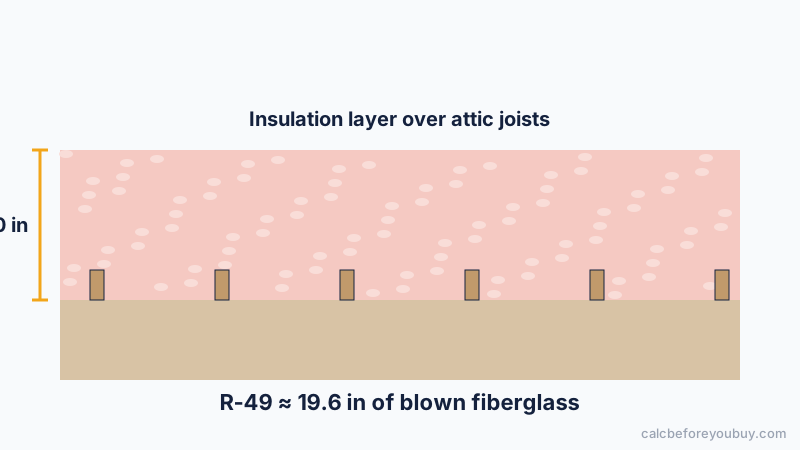
R-49 thickness by insulation type
| Material | Typical R per inch | Thickness for R-49 |
|---|---|---|
| Blown fiberglass | R-2.5 | 19.6 in |
| Blown cellulose | R-3.5 | 14 in |
| Fiberglass batts | R-3.2 | 15.3 in |
| Mineral wool batts | R-3.3 | 14.8 in |
| Open-cell spray foam | R-3.6 | 13.6 in |
| Closed-cell spray foam | R-6.5 | 7.5 in |
R-49 is an attic level recommended by ENERGY STAR for colder climates (and for warm zones when starting from scratch). These depths use typical R-per-inch values; the label or bag chart for your product gives the exact settled thickness.
How much material for 1,000 sq ft at R-49?
Blown fiberglass at 19.6 inches over 1,000 sq ft is about 1,633 cubic feet of installed insulation; cellulose at 14 inches is about 1,167 cubic feet. Bag coverage varies by product, so enter the coverage from the bag chart in the calculator above to get an exact bag count.
The math
Common questions
How thick is R-49 blown-in insulation?
About 19.6 inches of blown fiberglass or 14 inches of blown cellulose.
How thick is R-49 batt insulation?
About 15.3 inches for standard fiberglass batts (R-3.2 per inch); high-density batts are thinner.
Want the full method, tips and other sizes? See the insulation calculator guide.