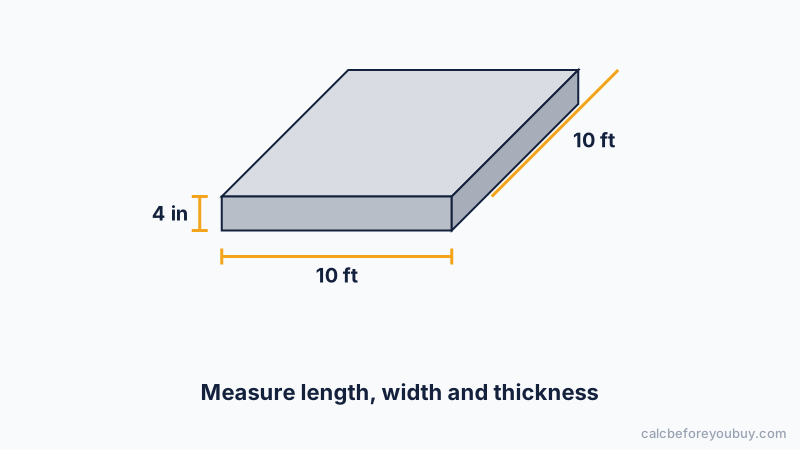
How the concrete calculator works
Concrete is sold by volume, so the job is to find the volume of your pour and convert it to the units you buy in: cubic yards for ready-mix, or bags for premix.
For round columns and post holes the volume is π × radius² × depth. The calculator then adds your waste allowance (10% by default) before converting to bags.
How much concrete is in a bag?
Standard premixed concrete bags yield roughly these volumes once mixed with water. Brands differ slightly, so check the yield printed on the bag you buy.
| Bag size | Yield per bag | Bags per cubic yard |
|---|---|---|
| 80 lb | 0.60 cu ft | 45 |
| 60 lb | 0.45 cu ft | 60 |
| 40 lb | 0.30 cu ft | 90 |
How thick should a slab be?
- 4 inches is the common thickness for patios, sidewalks, shed floors and garage-free slabs that only carry foot traffic.
- 5–6 inches is typical for driveways and slabs that carry vehicles or heavier loads.
- Footings, piers and anything structural should follow your local building code or an engineer's plan.
Why add 10% extra?
Forms bow, ground is rarely perfectly flat and some concrete always stays in the mixer or wheelbarrow. Running short in the middle of a pour creates a weak cold joint, so most contractors order 5–10% more than the exact volume. If your subgrade is uneven, go higher.
Bags or ready-mix truck?
Under about one cubic yard (45 bags of 80 lb), bags are usually the simpler choice. Above a couple of yards, the weight and the mixing time add up fast and ready-mix delivery is often worth pricing out. Many ready-mix suppliers charge a short-load fee for small orders, so call and compare.
Frequently asked questions
How many 80 lb bags of concrete make a yard?
About 45. An 80 lb bag yields roughly 0.6 cubic feet, and a cubic yard is 27 cubic feet (27 ÷ 0.6 = 45).
How many bags of concrete do I need for a 10x10 slab?
A 10×10 ft slab 4 inches thick is 33.3 cubic feet, which is 56 bags of 80 lb concrete with no extra, or 62 bags with 10% added for waste.
How much area does a cubic yard of concrete cover?
At 4 inches thick, one cubic yard covers 81 square feet. At 6 inches it covers 54 square feet.
Should I round up or down?
Always round up. Leftover bags can often be returned unopened; running out mid-pour cannot be fixed.