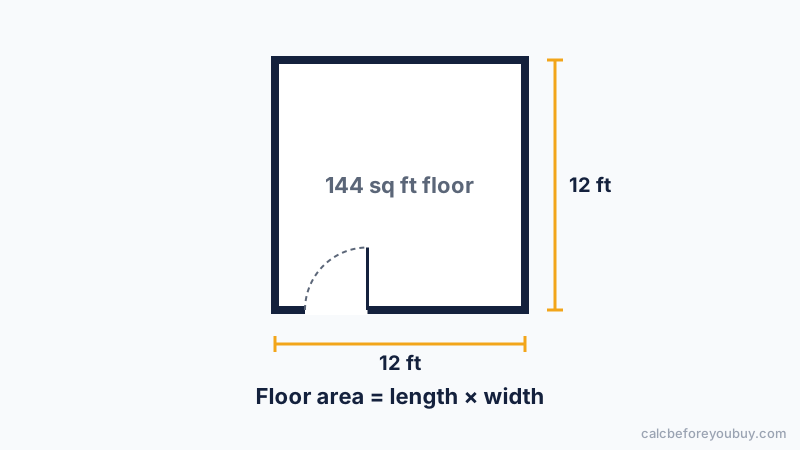
How the flooring calculator works
Area = Length × Width
Area to buy = Area × (1 + waste %)
Boxes = Area to buy ÷ sq ft per box (round up)
How much extra flooring should you buy?
Every row ends with a cut piece, and some planks will have defects. Installers commonly add:
- 5–7% for a simple rectangular room laid straight
- 10% as a safe default for most rooms
- 15% for rooms with lots of corners, closets or a diagonal layout
- 20% or more for herringbone and chevron patterns
Keep one unopened box after the job. If a plank is damaged years later, a matching replacement may no longer be sold.
How to measure a room
Measure wall to wall at the widest points and round up to the next half foot. For L-shaped rooms, split the floor into two rectangles, calculate each and add them. Include closets and the space under appliances that will get flooring.
Don't forget
- Underlayment (unless your planks have it attached) — buy the same square footage as the floor.
- Transition strips at doorways and baseboard or quarter-round for the edges.
- Let laminate and wood acclimate in the room per the manufacturer's instructions.
Frequently asked questions
How many boxes of flooring do I need for a 12x12 room?
144 sq ft plus 10% waste is 158.4 sq ft. With boxes of 20 sq ft, that is 8 boxes.
How much extra flooring should I buy?
10% is the common default. Use 5% for simple rectangles and 15–20% for diagonal or herringbone layouts.
Do I need to include closets?
Yes, if they will get the same flooring. Measure them separately and add the square footage.