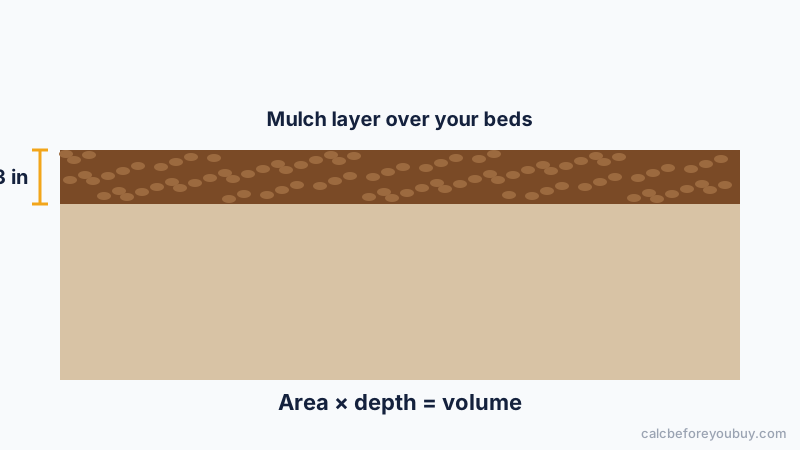
How the mulch calculator works
How deep should mulch be?
For most landscape beds, 2–3 inches is the sweet spot: deep enough to block weeds and hold moisture, shallow enough for water and air to reach the roots. Fine mulches can go a little thinner; coarse bark nuggets a little deeper. Topping up an existing bed usually needs only 1 inch.
Keep mulch a few inches away from tree trunks and plant stems. Mulch piled against the bark (“volcano mulching”) traps moisture and invites rot and pests.
Mulch coverage chart
| Depth | 1 cubic yard covers | 2 cu ft bag covers |
|---|---|---|
| 1 in | 324 sq ft | 24 sq ft |
| 2 in | 162 sq ft | 12 sq ft |
| 3 in | 108 sq ft | 8 sq ft |
| 4 in | 81 sq ft | 6 sq ft |
Bags or bulk?
One cubic yard equals 13.5 bags of 2 cu ft. For small touch-ups bags are convenient; once a job needs more than 2–3 yards, bulk mulch from a landscape supplier is usually much cheaper per yard — compare delivery fees.
Frequently asked questions
How many bags of mulch in a yard?
13.5 bags of 2 cubic feet, or 9 bags of 3 cubic feet.
How much area does a yard of mulch cover?
108 square feet at 3 inches deep, 162 square feet at 2 inches.
How do I measure a curved bed?
Break it into rough rectangles and circles, find each area, and add them. For a circle, area = 3.14 × radius². Our square footage calculator can help.
Should I remove old mulch first?
Usually not. Rake and loosen it, then top it up so the total depth stays around 2–3 inches.